
Trustworthy IT and Software-Defined Systems: it’s all about connecting the dots
This article examines the extent to which collaboration between academic research, applied research, and industry can be successful. It highlights how the EvIT program facilitates synergies and provides stimulus for research transfer. This is demonstrated specifically using the example of the BMFTR project "tSDX – trustworthy Software-Defined X".
As an institute that is part of the Fraunhofer Society, our main job is to connect research with the needs of businesses in Germany and Europe. At the Fraunhofer Institute for Experimental Software Engineering (IESE), we have a particular emphasis on embedded systems and information technology. Based on this, we researchers have observed that cyber-physical systems are increasingly defined by software. Therefore, in the BMFTR-funded project “tSDX – Software Defined X,” we are investigating what a multi-domain reference architecture might look like in order to implement software-defined systems more efficiently.
Naturally, we keep a careful eye on Cyberagentur's EvIT project and wonder if there are any possible results that could be applied to business in the upcoming year or two. Are there any activities that relate to the issues of technological sovereignty and competitiveness in Germany and Europe?
Indeed, we can clearly see the synergies that urgently need to be connected!
The observation
Perspective on EvIT
The EvIT project by the Cyberagentur is advancing formal verification methodologies to improve IT security at its core, meaning the development of processes to mathematically prove security robustness for both software and hardware. EvIT aims for a future where IT security transitions from reactive fixes to evidence-backed prevention from the design stage.
Researchers are successfully demonstrating their first outcomes as well as improved formal verification workflows. For long-term adaptation, the message needs to be spread so that awareness can be raised and followed by adaptation. But the following questions would still need to be answered even if a lot of engineers working on software and hardware projects knew about EvIT:
- How does this (EvIT) assist me in solving my daily issues?
- What is the cost of integration?
- What is the actual benefit of formal methods for an engineer who perceives it as an abstract concept by universities?
- Is the effort of formal methods acknowledged by certification entities?
This encourages us to examine the difficulties that engineers and their organizations currently confront in more detail.
Perspective on industry needs
Today’s hardware and software engineers face mounting pressure to deliver faster, smarter, and more secure products under tight deadlines and shrinking budgets. Furthermore, the need to develop and deploy technological sovereign products became one of the most important tasks in Europe.
On the hardware side, the teams struggle most with global supply chain disruptions, which makes the need for trustworthy hardware urgent. Hardware exploits also present an increasing threat surface for attackers, necessitating the use of advanced mitigation techniques.
On the software side, the engineers are confronted with exploding codebases and exponentially growing cybersecurity threats due to the usage of AI and Large Language Models (LLMs). Not to neglect that maintaining legacy dependencies is a time-consuming task, which can quickly become incomprehensible.
By bringing together both sides, a challenge appears, which is also a common target state: handle software across a variety of different hardware platforms across the cloud-edge-continuum. The Cloud-Edge-Continuum, represented in Figure 1, shows a broad range from resource-limited edge devices with low computing power to almost unlimited computing power in data centers. When both sides work toward each other, they can both benefit from each other's workflows. This is hardly surprising, because then software could easily be moved through the continuum regardless of the underlying hardware, which would be an ideal use case for dynamic computational offloading. Essentially, the goal here is to decouple software and hardware from one another. This should allow portable software, which is platform independent, and more hardware that could be accessible for deployment. But today’s reality looks scattered: both teams have to support many legacy devices with complex isolated toolchains. They are in the middle of the transition and must collaborate more closely than ever. Hardware and software engineers are adopting AI-assisted workflows and trying to keep pace with rapid changes in standards, regulations, and customer expectations – all while managing technical debt, talent shortages, and the risk that today’s architecture may be obsolete tomorrow.
From the companies that employ these engineers, the challenge is turning technical complexity into business results: they must balance rapid innovation against vs. cost/profitability and shorten time-to-market vs. risk. Also, the geopolitical situation of a technological sovereign Europe is increasingly becoming a competitive factor, because of its dependence on third-party information technologies. Terms such as App Store, digital twin, updatability, secure-by-design as well as faster certification processes are frequently cited as goals by management at various companies. Of course, from a management perspective, all of this should contribute to a higher return on investment.
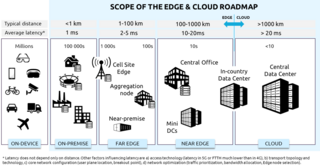
Figure 1: A representative illustration of the cloud-edge continuum. Image by CEO Roundtable “Shaping the Next Generation Cloud Supply for Europe”. “European industrial technology roadmap for the next generation cloud-edge offering”(2021).
Software Defined X – Combining the visions of engineers and management
Engineers and management are joining forces in more and more companies, as the abilities like fast updates on critical systems or app stores go hand-in-hand with the decoupling of hardware and software. So industrial initiatives are often formed around the term “Software-Defined” and sometimes alongside “hardware enabled” in the sub clause.
Traditional development approaches closely couple hardware and software, as seen in Figure 2. Changes to a component often require complex adaptations to the entire system architecture. Software-Defined X as a paradigm breaks through these boundaries and makes it possible to update and further develop software independently of the underlying hardware. This decoupling of hardware and software enables companies to react more quickly to new requirements, shorten development cycles, and implement innovative functions independently of physical components. As stated above, this results in more flexible systems but also considerable cost savings in maintenance and operation. Thus, the central advantage of the paradigm is continuous development and deployment within the cloud-edge-continuum (like the CI/CD approach).
Instead of relying on rigid, fixed systems, Software-Defined Everything enables continuous software updates - as an abstract example, similar to app updates on your phone. These updates not only provide security improvements but also offer new functions and optimizations that give companies a clear competitive advantage.
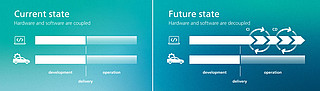
Figure 2: Traditional approach on the left side, where hardware and software are tightly coupled. On the left side is the Software-Defined X approach, where software can be easily updated in a continuous manner. Image by Fraunhofer IESE.
Current and other notable domain-specific initiatives in this area include, for example, the “Software Defined Vehicle” initiative coordinated by the Eclipse Foundation, as well as developments related to “Software Defined Defense.”
So many dots – let’s draw a connection
Both perspectives have no single time stamp; it was a process of moving between both worlds for some time and talking to the right people. (To be honest, the density of visionary people in EvIT is extremely high).
However, two bolt statements follow from these observations:
1. EvIT provides the trustworthy foundation that enables the industry to realize its ambitions for a technologically sovereign Europe with unique competitive advantages.
2. Software Defined X provides both a paradigm and a vision that brings together the EvIT results and the needs of the industry.
Unfortunately, no one talks about these synergies! Most likely, everyone is too busy with their own work – whether it's research or day-to-day business – so they might simply overlook these two connections.
Let's address the aforementioned queries and examine why it is possible to conclude that EvIT and Software Defined X are mutually beneficial.
How does this (EvIT) assist me in solving my daily issues?
After the EvIT projects have been completed, they are approximately in the experimental or demonstration pilot phase, with a TRL of 4-5. This may look like an early stage, but the next step is industrial adaptation. This is right before handover and is a kind of "last mile" problem. For adaptation to happen, the right people need to be aware of EvIT for them to not have to do the same work twice. Thus, this is a common task for Fraunhofer institutes to illustrate the economic benefits of research. The central thesis of this article is that the outcomes of EvIT provide reliable tools and processes that are an ideal fit for the foundational layer of next-generation (software-defined) products.
Consequently, the implementation of a robust software and hardware architecture will leave numerous daily challenges outdated, including the aforementioned AI cyberattacks, platform diversity, and competitiveness. This opens the door to numerous business objectives that are more focused on customer-centric values and approaches like app stores.
What is the cost of integration?
As always: there is no free lunch. But economies of scale can be realized at the foundational architecture level, such as operating systems or CPUs. Once the ideas behind EvIT are more developed and their business value is proven, it will be easy for businesses to adapt and add them to their existing systems. In addition, companies may capitalize on the EvIT's foundational work through public funding. In any case, whenever the product design or development process is altered, integration costs are inevitably incurred. The sole uncertainty is the extent of these expenses and the complexity of the integration. However, one of the primary objectives of software-defined systems is to reduce the cost of future integration by reducing the coupling between individual software components. In short, the objective of both is to follow a path that minimizes integration expenses.
What is the actual benefit of formal methods for an engineer who perceives it as an abstract concept by universities?
Given the vast amount of AI-generated code—and the incalculable consequences it entails—formal verification is becoming even more important. This is based on the fact that mathematical proof can be used to demonstrate true determinism in system behavior.
This does not mean that every engineer must also concern themselves with formal verification. Rather, it means that one should increasingly consider formally verified tools or software (components). Ideally, companies should engage more deeply with this topic. To this end, we recommend contacting the EvIT project, as it serves as a hub for passionate advocates of the field—the enthusiasm of the project partners helps enormously in raising awareness of the topic within companies.
Is the effort of formal methods acknowledged by certification entities?
This is a passionate discussion, but it picks up where the previous question ended: awareness of formal methods must continue to be raised among the public. Projects such as EvIT, as well as the BMFTR-funded project “tSDX—Trustworthy Software-Defined X,” contribute to this effort. In tSDX, for example, discussions are taking place with various stakeholders regarding a kind of blueprint for precisely these trustworthy, software-defined systems. This process involves everyone from certification bodies and software vendors to end users who develop software-defined products. Thus, tSDX aims to bridge the gap between EvIT and industry—the fundamental premise of this blog post. Further information on tSDX can be found here.
Conclusion
From the perspective of Fraunhofer IESE, EvIT's project design perfectly captures the zeitgeist and addresses the challenges the industry is facing. Often, different terms are used, yet the same goals are pursued. This article therefore boldly proposes creating a common vision under the term “Software-Defined X + Hardware-Enabled X.”
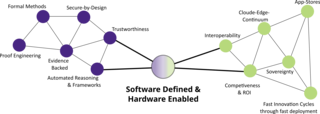
Figure 3: the perspective of this blog post on how EvIT and industrial needs should come together under the term Software-Defined X. Image by the author.
About the Author
Nils Brand works at Fraunhofer IESE in the “Embedded Systems Engineering” department. He focuses primarily on software-defined systems, software architecture, and digital sovereignty. As a co-author of the Bitkom guide “Software-Defined Vehicle,” Nils Brand applies these principles to the defense (“Software-Defined Defense”) and aerospace sector.